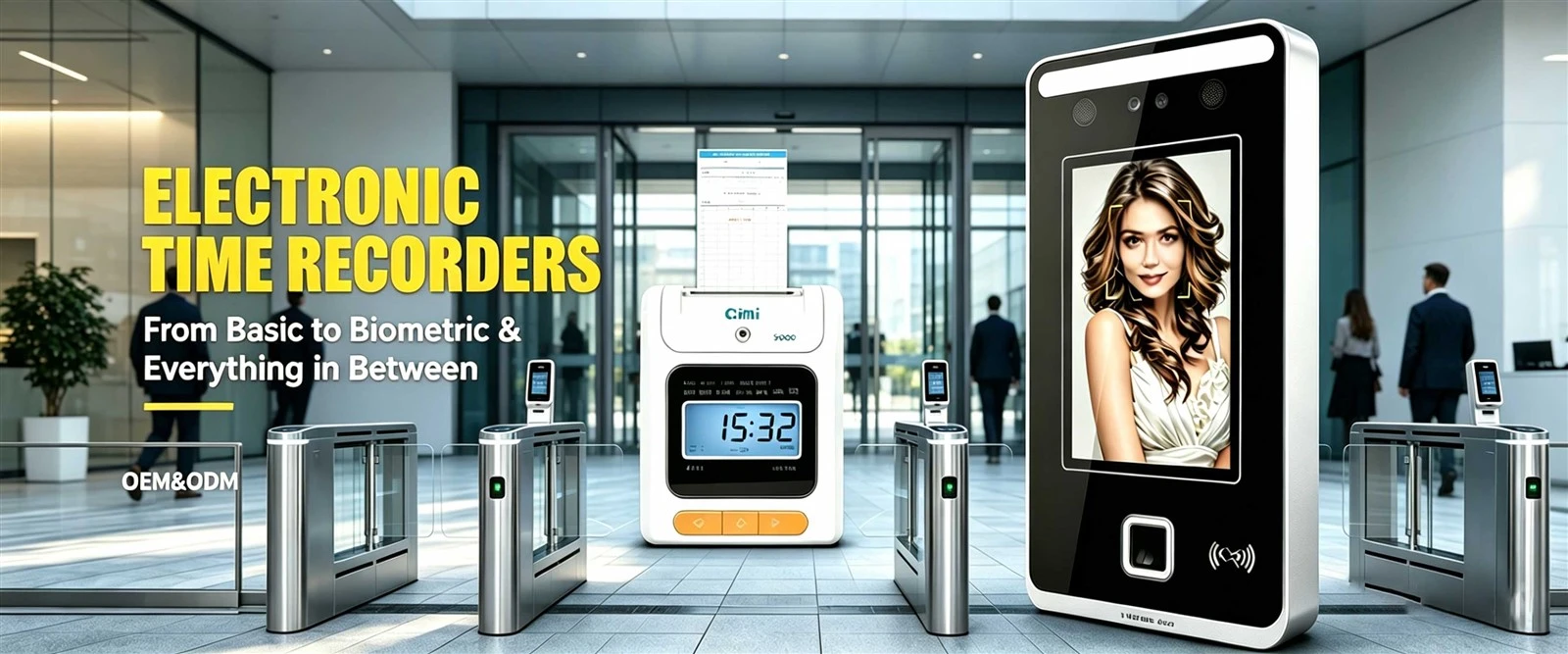
Accurate employee attendance tracking is the foundation of payroll calculation, overtime accounting, shift scheduling, and workforce performance evaluation. As office automation upgrades spread worldwide, traditional manual sign-in methods have been completely replaced by intelligent time attendance machines, helping businesses standardize HR management and eliminate manual errors.
Modern commercial attendance devices fall into three mainstream categories: paper punch card time recorders, digital fingerprint attendance terminals, and AI facial recognition attendance machines. Each type features unique operating logic, efficiency performance, and applicable scenarios, matching the needs of small offices, medium enterprises, and large industrial factories respectively.
What Is an Attendance Machine?
Also known as a time recorder or employee clock-in machine, an attendance machine is professional office hardware designed to record employee check-in and check-out timestamps. It verifies staff identity via paper cards, passwords, fingerprints, facial biometrics, or RFID cards, and automatically archives daily attendance data.
Standard QIMI attendance devices help businesses achieve core HR goals: record real-time working hours, statistically track late arrivals, early departures, and absences, manage multi-shift overtime schedules, export standardized attendance reports, reduce manual spreadsheet errors, and drastically improve overall HR operational efficiency. All QIMI attendance machines pass CE, FCC, and RoHS certifications for global commercial use.
1. Paper Punch Card Time Recorders
Paper punch machines are the most traditional and cost-effective entry-level attendance solution. Employees insert dedicated paper time cards into the device, and the high-precision thermal printing system automatically stamps accurate time and date records.
Core Advantages: Ultra-simple operation, low initial procurement cost, no complicated software or network requirements, fully offline operation for unstable network environments, and intuitive physical records for quick manual verification. QIMI S-200P and S-990 paper punch models adopt ink-free thermal printing, lowering long-term consumable costs and supporting 24-hour stable operation.
Ideal Scenarios: Small startups, workshops, construction sites, warehouses, and small teams with low digital management requirements and fixed working shifts.
2. Fingerprint Attendance Machines
Fingerprint attendance terminals verify employee identity through unique fingerprint biometric features. Staff register their fingerprint templates on the device for the first use, then complete one-touch clock-in by pressing the fingerprint sensing area every day.
QIMI EN-260 industrial fingerprint terminal adopts the latest EBKN Finger V3.0 algorithm, supporting 360° free-angle fingerprint recognition with a fast matching speed of ≤0.8 seconds. It stores up to 3,000 fingerprint templates and 150,000 attendance logs, with an ultra-low False Acceptance Rate (FAR) of 0.00001% and False Rejection Rate (FRR) of 0.1%.
Core Advantages: No physical card carrying required, effective proxy clock-in prevention, high identification accuracy, full electronic data management, and strong stability for long-term high-frequency use.
Limitations: Recognition efficiency may drop slightly if fingers are overly dry, worn, sweaty, or covered with dust or oil stains.
Ideal Scenarios: Small and medium-sized enterprises, factory workshops, and administrative teams pursuing cost performance and basic anti-cheating functions.
3. Facial Recognition Attendance Machines
AI facial recognition attendance devices capture and analyze employee facial feature data via high-definition binocular cameras to complete contactless identity verification. Staff only need to stand in front of the device for quick clock-in without any physical contact.
QIMI EN-K12-A and EN-Q32 facial recognition terminals support a recognition distance of 0.5–2.5 meters, with a ultra-fast 0.6-second recognition speed. They adapt to complex light environments including backlight and dim light, and support mask and glasses recognition. Equipped with live detection technology, they effectively block photo, video, and screen spoofing.
Core Advantages: 100% contactless operation, zero wear and dirt interference, top-level anti-proxy clock-in performance, queueless high-frequency clock-in, and intelligent data statistics.
Ideal Scenarios: Modern office buildings, large factories, schools, medical institutions, and standardized public enterprises.
How to Choose the Right Attendance Device for Your Business?
Businesses can select targeted equipment based on key factors: team size, anti-cheating demands, network management requirements, report export needs, on-site environmental conditions (dust, humidity, high-frequency use), and overall budget and maintenance costs. Small offices can choose paper punch machines or basic fingerprint devices, while medium and large enterprises prioritize biometric facial recognition terminals for efficient digital management.
Conclusion
There is no one-size-fits-all attendance device for all businesses. QIMI provides a full lineup of time recorders including paper punch machines, basic digital attendance devices, and industrial-grade biometric fingerprint and facial recognition terminals, covering all scenarios from small teams to large factories to help global enterprises build efficient, standardized HR attendance management workflows.
If you need bulk quotation or OEM customization, contact our sales team via WhatsApp86=13728420209/Email:wendy@qimi-timerecording.com