

Hey there! As a punch time clock supplier, I often get asked about how these nifty devices calculate pay for part - time employees. It's a crucial topic, especially for small businesses and employers who want to ensure accurate compensation. So, let's dive right in and break it down.
How Punch Time Clocks Work
First off, let's understand the basics of punch time clocks. These devices are designed to record an employee's start and end times for their shifts. There are different types of punch time clocks out there, like the Bundy Clock Time Recorder With Built-in Battery. This type uses a punch card system where employees insert their cards into the clock, and it stamps the time on the card.
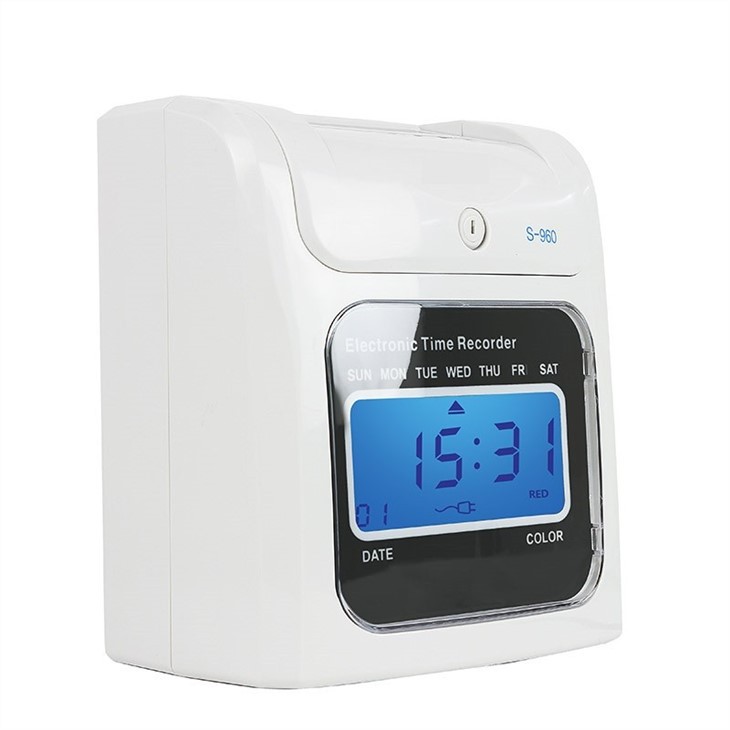
Another popular option is the punch card time clock for sale. These are often electronic and can be more accurate and efficient than the traditional mechanical ones. They can store data electronically, which makes it easier to calculate pay later on.
Then, there's the geomaster time recorder punch card full set. This is a comprehensive system that includes all the necessary components for accurate time tracking.
Recording Employee Hours
When a part - time employee punches in and out, the punch time clock records the exact time. This data is crucial for calculating pay. For example, if an employee punches in at 9:00 AM and punches out at 1:00 PM, the clock will record those times. The difference between the punch - out and punch - in times gives the total number of hours worked.
However, things can get a bit more complicated when there are breaks involved. Most employers allow employees to take a short break during their shift. For instance, a 15 - minute break is common for a 4 - hour shift. The punch time clock needs to account for these breaks. Some clocks have a separate function for recording break times. If an employee punches out for a break and then punches back in, the clock subtracts the break time from the total shift time.
Calculating Pay
Once the total hours worked are determined, it's time to calculate the pay. Part - time employees are usually paid an hourly rate. Let's say an employee has an hourly rate of $15. If they worked 4 hours in a shift, their pay for that shift would be $15 x 4 = $60.
But it's not always that simple. There are other factors to consider, like overtime. If a part - time employee works more than a certain number of hours in a week, they may be eligible for overtime pay. Overtime rates are usually higher than the regular hourly rate. For example, in many places, the overtime rate is 1.5 times the regular hourly rate. So, if an employee's regular rate is $15 per hour, their overtime rate would be $15 x 1.5 = $22.5 per hour.
The punch time clock needs to be able to identify when overtime has occurred. Some advanced punch time clocks can automatically calculate overtime based on the hours worked and the company's overtime policy.
Handling Different Pay Schedules
Part - time employees may be paid on different schedules, such as weekly, bi - weekly, or monthly. The punch time clock needs to be able to handle these different pay schedules. For a weekly pay schedule, the clock will calculate the total hours worked in a week and then calculate the pay based on the hourly rate.
For a bi - weekly pay schedule, the clock will sum up the hours worked over two weeks and then calculate the pay. Monthly pay schedules work in a similar way, but over a longer period. The punch time clock should be able to store and calculate the data for these different time periods accurately.
Accuracy and Reliability
One of the most important aspects of a punch time clock is its accuracy. If the clock is not accurate, it can lead to incorrect pay calculations. This can cause problems for both the employer and the employee. For example, if the clock records an incorrect punch - in or punch - out time, the employee may be underpaid or overpaid.
Reliability is also crucial. The clock should be able to function properly at all times. It should not break down or lose data. That's why it's important to choose a high - quality punch time clock, like the ones I'm offering as a supplier.

Integration with Payroll Systems
Many modern punch time clocks can integrate with payroll systems. This makes the pay calculation process even more efficient. When the clock is integrated with a payroll system, the data from the clock is automatically transferred to the payroll software. This eliminates the need for manual data entry, which can be time - consuming and error - prone.
The payroll system can then use the data from the punch time clock to calculate pay, generate pay stubs, and handle other payroll - related tasks. This integration also ensures that the pay calculations are accurate and consistent.
Choosing the Right Punch Time Clock
If you're an employer looking for a punch time clock to calculate pay for your part - time employees, there are a few things to consider. First, think about the size of your business and the number of employees. If you have a small business with only a few part - time employees, a simple punch card time clock may be sufficient.
However, if you have a larger business with many part - time employees, you may need a more advanced clock that can handle a high volume of data and integrate with your payroll system. You also need to consider the features you need, such as the ability to record break times, calculate overtime, and handle different pay schedules.
Contact Us for Purchase and Consultation
If you're interested in purchasing a punch time clock for your business, I'd love to help. Whether you need a basic punch card system or a more advanced electronic clock, I can provide you with the right solution. We have a wide range of products to choose from, and our team can offer expert advice on which clock is best for your needs.
Don't hesitate to reach out to us to discuss your requirements and get a quote. We're here to make the process of calculating pay for your part - time employees as smooth and accurate as possible.
References
- "Time and Attendance Systems: A Comprehensive Guide" - This book provides in - depth information on different types of time and attendance systems, including punch time clocks.
- "Payroll Management for Small Businesses" - A useful resource for understanding how to calculate pay for employees, especially part - time employees.
- Industry reports on the latest trends in punch time clock technology and their impact on payroll calculations.